
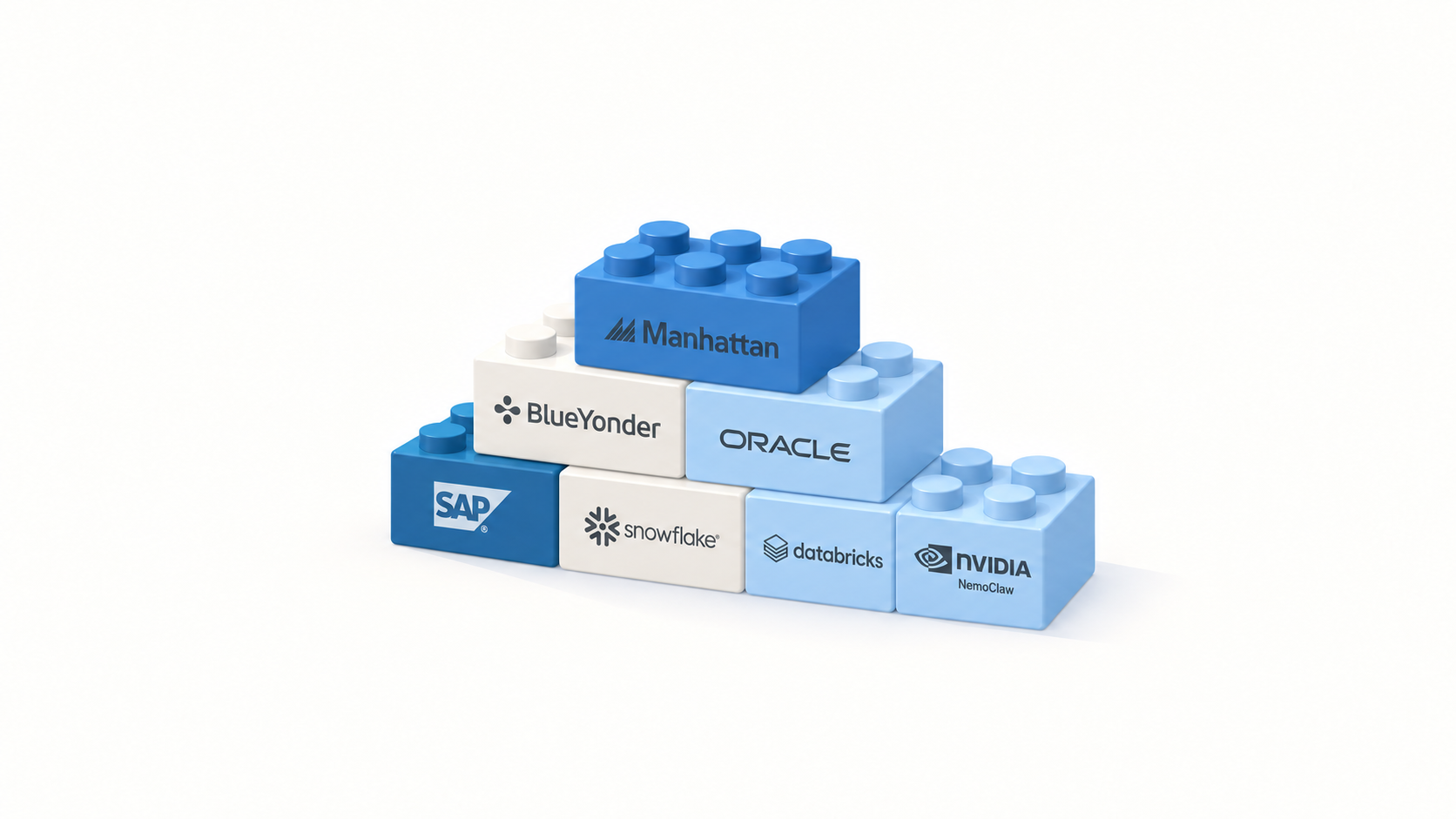
A warehouse AI agent might explain a failed wave, create a receiving record or keep working on a shipment exception as conditions change. Each leaves a different amount of work with the supervisor. The buying decision depends on who chooses the next step, who authorizes the change and who takes over when it fails.
This is a point-in-time assessment of seven agent offerings, published on October 7, 2026. Warehouse agents are evolving quickly. CrateOS will continue this investigation and revise the findings as technical documentation and credible deployment results change.
Our review finds substantial differences behind the shared agent label. External connectivity is widely described or documented. The sharper differences concern how work is organized, what controls the platform supplies and how much integration and operation remain with the enterprise. We found no comparable warehouse performance benchmark across these offerings.
Agency, authority and readiness develop separately
An agent can choose tools while remaining read-only. A fixed workflow can execute a transaction automatically. Human approval reveals the permission boundary, but says little about how the software chooses its steps. Anthropic’s engineering guide distinguishes predefined workflows from agents whose models direct the work.
Consider a late inbound trailer carrying stock for tonight’s shipments. An agent could identify affected orders, check inventory and labor, propose a response and, with permission, update the WMS. Following the exception through to dispatch also requires tracking progress, checking completed actions and handing over when the plan fails. Throughout this article, that scenario is illustrative.
Agent washing occurs when buyers are led to expect more agency or autonomy than the software provides. Gartner’s supply-chain warning concerns exaggerated claims and relabeled automation; it does not assess the products below. Missing public documentation alone is insufficient grounds to accuse a vendor of misrepresentation.
Gartner’s levels describe permission to act
Gartner’s May 2026 framework separates four autonomy levels. Our warehouse examples apply those definitions. These levels describe authority, with capability and operating reliability assessed separately.
| Level | Authority | Warehouse illustration |
|---|---|---|
| L1 · Observe | Reads scoped data and returns findings to the requesting user. | Reports orders affected by a failed wave. |
| L2 · Advise | Proposes actions. People review outputs and make system changes; the agent remains read-only. | Recommends a stock transfer for a supervisor to execute. |
| L3 · Act with Approval | Executes only after explicit human approval of each action. | Submits the specific stock transfer approved by a supervisor. |
| L4 · Act Autonomously | Acts within defined limits; people review exceptions and outcomes. | Transfers stock within approved limits and escalates exceptions. |
Scroll to follow the paths →
CrateOS illustration using Gartner’s level names. Paths show permission boundaries, not required technical architectures. Follow-through, process improvement, and the number of agents must be assessed separately.
A platform can support several permission levels. Oracle, for example, documents a human-approval setting for external tools. The configured workflow determines whether and when that setting applies. We therefore assign no single Gartner level to an entire vendor.
Seven offerings, different responsibilities
The scope includes each vendor’s agent platform or runtime, with packaged warehouse agents and developer examples as evidence. We reviewed public technical guides, release notes and product descriptions. We have not tested these offerings in a warehouse. Editions, licensing, regions and rollout status can affect availability.
| Agent offering | What the sources establish or describe | Evidence limit |
|---|---|---|
| Manhattan Agent Foundry | Developer examples combine authored workflows, helper-agent calls and a model step instructed to use tools. | External services are vendor-described; adaptive recovery and enforced approval remain unverified. |
| Blue Yonder domain agents + Orchestrator | Published client releases, a Copilot integration and a customer story add evidence beyond platform announcements. | Copilot sign-in and transaction limits are documented; broader agent execution and recovery remain unverified. |
| Oracle AI Agent Studio · Fusion 26C | Technical guides document external tools, specialist delegation, approvals, evaluation and deployment controls. | Integration and entitlement vary across Oracle applications. |
| SAP Joule Studio · classic edition | Guides document model-selected tools, external MCP connections and sequential specialist agents. | The findings apply to the documented classic edition. |
| Snowflake Cortex Agents | Technical guides document tool selection, code execution, shared toolsets and background runs. | Warehouse actions and transaction recovery require implementation. |
| Databricks Agent Bricks | Current guides document custom agent frameworks, governed tools, managed state, tracing and crash recovery. | The CLI is Beta. Coordination depends on the framework; legacy Supervisor examples have a different scope. |
| NemoClaw with OpenClaw | Runtime guides document tools, delegation, persisted state, recurring turns and containment. | NVIDIA identifies enterprise administration and fleet-operation gaps. |
Customer-restricted manuals limit this assessment. An example establishes a supported pattern without defining the platform’s ceiling. The charts distinguish technical evidence from vendor descriptions and carry no combined performance score.
Execution patterns and system reach
The matrix compares execution patterns with tool reach. Its rows are categories: defined steps, model-invoked tools, specialist delegation and recurring follow-up. These mechanisms can coexist; the row order carries no maturity ranking. Horizontal offsets separate labels within a reach category.
External access is common, although the evidence differs. Foundry’s platform description includes external services, agents and connections through Model Context Protocol (MCP), for tools, and Agent2Agent (A2A), for other agents. That prevents an application-only interpretation of Manhattan’s internal examples. Blue Yonder also describes connected systems; both retain open markers where reach or behavior is vendor-described.
The rows show selected execution patterns, without ranking adaptiveness. The columns distinguish application tools from connected systems.
- Manhattan
- Across connected systems
- Authored workflow + model tool step · mixed evidence; no application-only limit established
- Blue Yonder
- Across connected systems
- Claimed recurring coordination · vendor-described; technical validation pending
The technical examples reveal different execution patterns
Manhattan’s Store Capacity Alert exercise follows builder-defined service calls. Its Slotting Assistant lab adds helper-agent calls and a model step instructed to use tools after user confirmation. The 26.2 release description also covers customer MCP registration, validation and publishing controls, and usage dashboards. Foundry therefore supports more than the simpler example shows. The instruction alone does not establish an approval control enforced outside the model, or recovery after an unexpected result.
SAP’s May 2026 announcement describes a broader Joule Studio with a managed runtime and persistent memory. Our technical findings use the available classic-edition guides; its limits do not establish the broader runtime’s limits. The new runtime’s execution contracts and warehouse outcomes remain outside this documented scope.
SAP’s tool guide documents sequential subagents in the same classic-edition project. Oracle’s multi-agent guide documents specialist coordination. Snowflake’s agent toolsets share another agent’s tools; that mechanism does not establish separately executing specialist agents.
Databricks now directs new code-based builds to Agent Bricks CLI, a command-line tool for developers, with framework templates, managed state and deployment resources. Its legacy guidance distinguishes these builds from Supervisor Agent. Coordination in current custom builds depends on the selected framework; the legacy Supervisor provides a separately documented managed-delegation pattern.
Blue Yonder’s publisher-authored Warehouse Ops listing documents OAuth sign-in, a WMS subscription requirement and an important boundary: the Copilot agent does not commit transactions itself; actions occur in linked Blue Yonder applications. This applies to that integration. The broader agent platform describes domain agents, an orchestrator and memory; its execution and delegation contracts remain unverified.
Orchestrator’s app release history documents continued client development, including agent switching. A vendor-hosted Arcadia Cold story describes Warehouse Ops Agent co-development for shift handovers and staffing recommendations. Its reported 9% labor-productivity improvement belongs to Labor Management, not the agent. The agent work provides a customer example, without a measured agent outcome.
The May 2026 Model Training Factory announcement names Nemotron models and the NeMo Agent Toolkit for building and evaluating specialized agents. It targets warehouse exceptions first, with customer production expected later in 2026. We found no public confirmation of that milestone in this review. Naming the stack adds substance, but does not establish released permissions or recovery behavior.
The same six dimensions appear in every profile, with the supporting sources available beneath it. There is no combined score. A broader mechanism can add integration and operating work without improving a particular warehouse task.
Manhattan
Agent Foundry · developer examples
- System reach
- External services described; configuration unverified
- Adaptive steps
- Model tool step in authored workflow
- Action scope
- Configured business/API actions
- Continuity
- Scheduled background runs
- Coordination
- Authored helper-agent calls
- Readiness
- Partial operating evidence
Evidence and sources
- System reach
- Foundry describes external APIs and agents through approved service definitions, plus MCP/A2A connections. The reviewed labs do not establish their configuration contract. Internal examples do not establish confinement. Source 1 · Source 2
- Adaptive steps
- The Slotting Assistant lab combines authored branches and helper calls with a callGenAIService step instructed to use an available tool. This establishes a model tool step within the authored workflow, without establishing replanning after unexpected results. Source 1
- Action scope
- The Store Capacity exercise configures ticket creation. The Slotting lab instructs the model to use an assignment-creation helper after user confirmation; a prompt instruction does not establish an approval control enforced outside the model. Source 1 · Source 2
- Continuity
- 26.2 documents recurring nonconversational runs using cron or natural-language schedules. Retained case context and recovery across runs remain unestablished. Source 1
- Coordination
- The Slotting lab prescribes several callAgent helper calls. Dynamic specialist selection, concurrent workers and their lifecycle handling remain unestablished. Source 1
- Readiness
- 26.2 describes customer MCP registration, validation/publishing controls and usage dashboards. These release descriptions broaden the tutorial evidence; systematic evaluation and transaction recovery remain unestablished. Source 1
Blue Yonder
Domain agents + Orchestrator · public product evidence
- System reach
- External tools · vendor-described
- Adaptive steps
- Continuous reasoning · vendor-described
- Action scope
- No direct commits · Copilot integration
- Continuity
- Memory · vendor-described
- Coordination
- Orchestrator · vendor-described
- Readiness
- OAuth sign-in; other controls unverified
Evidence and sources
The Copilot integration documents sign-in and places transaction commits in linked applications. Broader orchestration and memory remain vendor-described. Client releases and a customer co-development story add delivery evidence, without establishing the full platform’s execution contract.
- System reach
- The Copilot integration connects to Blue Yonder WMS. Broader cross-system actions are vendor-described; a customer-configured agent API contract remains unverified. Source 1 · Source 2
- Adaptive steps
- The Model Training Factory announcement names Nemotron and NeMo Agent Toolkit. This identifies development technology without establishing released tool selection or replanning behavior. Source 1 · Source 2
- Action scope
- The Copilot listing explicitly places transaction commits in linked applications. The WMS FAQ describes human review. Broader platform action claims do not establish agent authorization semantics. Source 1 · Source 2 · Source 3
- Continuity
- Persistent memory is vendor-described. Client release notes establish ongoing delivery, not durable run state or recovery. Source 1 · Source 2
- Coordination
- The FAQ describes one warehouse agent with multiple skills; the platform describes broader domain-agent orchestration. Its delegation and worker lifecycle contracts remain unverified. Source 1 · Source 2
- Readiness
- The Copilot listing documents OAuth 2.0 through Blue Yonder IAM and reauthentication. Role-based action controls, audit traces, systematic evaluations and agent release procedures remain unresolved. Arcadia Cold describes agent co-development; its 9% improvement is a Labor Management result, not an agent outcome. Source 1 · Source 2
Warehouse Ops integration and limits
Model Training Factory announcement
Oracle
AI Agent Studio · Fusion Applications 26C
- System reach
- External APIs / MCP tools
- Adaptive steps
- Model selects tools or specialists
- Action scope
- Configured business/API actions
- Continuity
- Task continuation
- Coordination
- Specialist delegation
- Readiness
- Four control areas documented
Evidence and sources
- System reach
- External REST, MCP and cross-platform A2A connections are documented. WMS integration and entitlement remain deployment-specific. Source 1
- Adaptive steps
- Supervisor agents delegate work; workflow builders also support prescribed paths. The execution pattern depends on the agent design. Source 1
- Action scope
- Configured tools and workflow nodes can perform actions, subject to security and approval settings. Source 1
- Continuity
- The A2A API documents task identifiers, state polling and resumption with tasks/send. That supports continuation; it does not establish proactive case ownership. Source 1
- Coordination
- Documented supervisor and multi-agent patterns coordinate specialized agents. Source 1
SAP
Joule Studio · classic edition documented
- System reach
- External APIs / MCP tools
- Adaptive steps
- Model selects tools or specialists
- Action scope
- Configured business/API actions
- Continuity
- Not established
- Coordination
- Sequential specialist delegation
- Readiness
- Partial operating evidence
Evidence and sources
- System reach
- Classic edition documents external MCP destinations. Interactive OAuth and principal propagation are not supported for those connections. Source 1
- Adaptive steps
- The classic agent creation guide specifies an advanced model that plans and selects tools, with a maximum thinking-step limit. This establishes model-directed execution for that edition. Source 1
- Action scope
- Agent tools include configured Joule skills and MCP operations. Model-generated code execution is not established by the reviewed guides. Source 1 · Source 2
- Continuity
- Classic-edition guides do not establish persistent tasks and follow-up. The broader May 2026 Joule Studio announcement describes managed runtime and long-term memory; those claims are outside this classic technical scope. Source 1
Snowflake
Cortex Agents · managed data platform
- System reach
- External APIs / MCP tools
- Adaptive steps
- Model selects tools or specialists
- Action scope
- Generated code or shell
- Continuity
- Threads and background runs
- Coordination
- Tools or prescribed calls
- Readiness
- Four control areas documented
Evidence and sources
- System reach
- Remote MCP and backend tools supported; actual access is configured. Source 1
- Action scope
- Code execution and custom tools supported. Tool availability does not grant warehouse write authority. Source 1
- Continuity
- Threads and asynchronous runs support context and background work; scheduled case ownership needs implementation. Source 1
- Coordination
- Agent toolsets reuse another agent’s tools. This establishes tool sharing, not native delegation to separately executing specialist agents. Source 1
Databricks
Agent Bricks · CLI Beta + legacy Supervisor
- System reach
- External APIs / MCP tools
- Adaptive steps
- Model selects tools or specialists
- Action scope
- Generated code or shell
- Continuity
- Managed state and recovery handler
- Coordination
- Framework coordination; legacy delegation
- Readiness
- Four control areas · CLI Beta
Evidence and sources
- System reach
- Current Agent Bricks supports governed models and tools through Unity Gateway, managed MCP and custom code. Permissions and tool bindings are configured for the application or requesting user. Source 1 · Source 2
- Adaptive steps
- Current templates use LangGraph or the OpenAI Agents SDK; the selected framework organizes the model/tool loop. Legacy Supervisor separately documents task delegation and synthesis. Source 1 · Source 2
- Action scope
- An optional Sandbox tool runs generated code with scoped catalog access. Its network egress is unrestricted and not configurable. This differs from the legacy Supervisor built-in sandbox; external actions still require configured tools and authority. Source 1
- Continuity
- Managed sessions and memory persist context. Deployed DurableAgentServer retains run state and starts recovery attempts through a registered handler. This does not establish reconciliation of partially completed external warehouse writes; local development state is not durable. Source 1 · Source 2
Current Agent Bricks CLI (Beta)
Agent server and crash recovery
NemoClaw
OpenClaw in NemoClaw · reference runtime
- System reach
- External APIs / MCP tools
- Adaptive steps
- Model selects tools or specialists
- Action scope
- Generated code or shell
- Continuity
- Persisted state and recurring turns
- Coordination
- Concurrent isolated workers
- Readiness
- Enterprise operating gaps stated
Evidence and sources
- Adaptive steps
- OpenClaw supplies the model-and-tool loop; NemoClaw supplies containment and runtime integration. Source 1
- Action scope
- Commands, files and tools can change systems where allowed. Network approval does not authorize every business action. Source 1
- Continuity
- Workspace and state files survive normal restarts; sandbox destruction deletes them unless backed up. Heartbeat turns are documented. This supports recurring work with persisted state, not guaranteed session recovery or warehouse completion. Source 1 · Source 2
- Coordination
- OpenClaw supports subagent delegation within configured policies. Source 1 · Source 2 · Source 3
- Readiness
- NVIDIA identifies enterprise administration and fleet-operation gaps in the reference stack. The adopter must supply those operations and warehouse support. Source 1
In the trailer scenario, delegation could divide stock, labor and transport analysis. Background execution could finish after a browser closes. Recurring turns could revisit changing conditions. None of those mechanisms alone establishes that the agent knows which orders remain at risk or has completed dispatch. That work requires business state, reliable actions and a clear handoff.
Enterprise readiness depends on the operating service
Suppose the WMS accepts a stock change but the agent loses the response. A retry could repeat the change. Recovery requires determining what happened before attempting another write. Platform state persistence and recovery from a partially completed warehouse transaction address different failures.
Our readiness comparison covers four documented control areas: access, traces, systematic evaluation and release procedures. Oracle, Snowflake and the updated Agent Bricks scope document those foundations. This is documentation coverage; it does not certify a warehouse service or remove Beta limitations.
The reviewed documentation establishes different operating controls for each offering.
- Blue Yonder
- Domain agents + Orchestrator · public product evidence
- Sign-in documented; controls unverified
Oracle’s evaluation guide specifies expected answers, metrics and pass/fail criteria. Snowflake documents agent evaluations. Databricks documents evaluation datasets alongside CLI deployment. Its agent server supports interrupted-run recovery; customer recovery logic still determines how external effects are reconciled.
Foundry’s 26.2 release notes document schedules and lifecycle controls. SAP’s classic guides document testing and traces. The reviewed evidence does not establish all four areas for those scopes. Blue Yonder documents OAuth sign-in for its Copilot integration; role-based action controls, audit traces, systematic evaluations and agent release procedures remain unresolved. Restricted documentation can leave existing controls unverified.
NVIDIA’s enterprise-readiness guidance explicitly assigns responsibilities. Cross-host fleet management is manual, operator role controls are outside NemoClaw’s scope, and enterprise identity integration is roadmap-only. OpenShell owns gateway availability; the operator owns fleet recovery. Those are stated boundaries, stronger evidence than a missing document.
The investment includes integration and service ownership
Supply-chain platforms bring application context. Data platforms provide infrastructure for a warehouse application. A reference runtime offers greater deployment control with more operations left to the adopter. Each can support useful work at a different implementation burden.
The cost includes integration engineering, model and hosting usage, evaluation, on-call support and supervisor interventions. Our sources do not establish comparable total costs or returns. For the COO, the unresolved measure is how much effort remains after the agent responds or acts. For the CIO, it is who owns that complete service across platform, connectors and models.
Sovereignty concerns the complete agent
Model choice, runtime hosting and data retention are separate decisions. An open model can run in a provider’s service. A proprietary agent platform can call an open model while using a different model for planning. Sensitive warehouse data can pass through inference, memory, retrieval, tools, traces and backups.
Downloadable weights also do not establish open source status under the Open Source Initiative’s AI definition. The model license and agent-runtime license govern different components. Open APIs establish connectivity, without settling who operates the system.
Choose the service
Provider, processing region and retention depend on the endpoint. Open weights can still run in a vendor’s service.
Control inference
Permitted model weights run on dedicated cloud or private infrastructure. The agent platform may remain a managed service.
Operate the system
The enterprise hosts the agent, model, memory and tools, and owns updates, security, capacity, recovery and support.
NemoClaw’s source license and local inference guidance establish a route to controlling runtime and model execution. The enterprise then owns capacity, updates, credentials, observability and recovery. Local inference alone does not establish disconnected operation.
Managed offerings expose different choices. Oracle documents supported-provider model selection. SAP documents model settings and a sovereign-service portfolio, with agent availability dependent on the configuration. Snowflake’s orchestration-model list differs from its broader open-model catalog. Current Databricks Unity Gateway and custom agents provide model choices; managed hosting and inference routing still impose dependencies. Blue Yonder reports using open Nemotron models in its Model Training Factory. That does not establish customer model choice or self-hosting. Those options also remain unestablished for Foundry in the reviewed evidence.
Zero retention depends on each data path
A promise not to train on prompts addresses data use. Zero data retention (ZDR) addresses storage. Conversation memory, tool logs and warehouse audit records can persist even when the model endpoint retains no request data.
AWS, Google and Azure document endpoint- and feature-specific conditions. Snowflake documents cross-region inference controls; Databricks’s Foundation Model API policy permits processing outside the originating region or cloud. Neither an account’s storage region nor one endpoint’s retention promise establishes the complete agent’s boundary.
Adoption depends on the warehouse task
An enterprise can experiment with a read-only investigator while demanding stronger evidence for automatic inventory changes. Risk, integration effort and the available operating team affect how a deployment progresses.
The illustration applies Rogers’s adopter categories to those operating choices. We have no comparable market-adoption dataset, so it carries no vendor positions.
A read-only investigation and an automatic inventory change can follow different adoption paths in the same operation. Risk, implementation effort and service ownership shape the evidence needed before rollout.
Innovators
Explore what is possible
- Typical technology fit
- Custom agents on a development platform or independently operated runtime.
- Readiness needed
- Engineering capacity to build tools and operate the pilot.
- Risk posture
- Accepts uncertainty in a sandbox; live actions remain constrained.
- Evidence threshold
- A repeatable demonstration and tested containment.
Early adopters
Prove a useful outcome
- Typical technology fit
- One tailored warehouse agent, with review before consequential actions.
- Readiness needed
- An operational sponsor, usable data, and a team owning integration.
- Risk posture
- Accepts implementation effort for a measurable advantage.
- Evidence threshold
- A supervised pilot with value, recovery, and support evidence.
Early majority
Scale proven work
- Typical technology fit
- Supported packaged features or a managed custom agent with references.
- Readiness needed
- Repeatable deployment, training, monitoring, and service ownership.
- Risk posture
- Needs evidence from comparable operations.
- Evidence threshold
- Reliable outcomes across representative exceptions.
Late majority
Adopt a dependable service
- Typical technology fit
- Standard application capabilities with clear support and limited customization.
- Readiness needed
- Predictable cost, established procedures, and supported upgrades.
- Risk posture
- Needs low disruption and a straightforward fallback.
- Evidence threshold
- Contracted service commitments and a rehearsed rollout.
Laggards
Protect continuity
- Typical technology fit
- Existing WMS rules and read-only assistance for a justified problem.
- Readiness needed
- A clear benefit and an adoption path compatible with current constraints.
- Risk posture
- Change costs or failure consequences can outweigh early adoption value.
- Evidence threshold
- Evidence that the change improves the current process.
Multiple agents add coordination responsibilities
A coordinator can assign stock, labor and transport analysis to specialists and reconcile their findings. Anthropic’s production research system documents this arrangement and its resource costs. Agent count leaves authority and warehouse reliability unresolved.
“Swarm” covers several arrangements, including coordinator-led workers, handoffs and peer collaboration. Delegated work can outlive the parent request or conflict over a resource. Two agents reallocating the same stock can produce an inconsistent result even if each local decision appears reasonable. The coordination features reviewed here do not establish conflict-free warehouse execution.
Process improvement adds another responsibility: finding recurring failures, evaluating a revision, deploying it with appropriate authority and measuring the result. Tool-refinement research supports that engineering technique. The reviewed sources do not establish autonomous improvement of a warehouse procedure in production; it adds no level to Gartner’s permission framework.
What the research establishes
These offerings supply different combinations of warehouse context, tool selection, coordination, operating controls and deployment choice. Those differences determine what an enterprise can build and what it must support. An investigation leaves execution with the supervisor. Resolving an ongoing exception also requires verified actions and follow-up until the work is complete.
The largest evidence gap is demonstrated exception resolution: completed work, recovery after failure and reduced effort for supervisors on comparable warehouse tasks. That gap limits claims of performance leadership and return on investment. Future updates will prioritize those outcomes alongside changes in technical capability.
CrateOS provides operations and implementation services. This article is our public-documentation assessment, with no independent product benchmark or external analyst review. We welcome factual corrections from operators, researchers and vendors. Continue the conversation.